
Now choosing the right prefabricated container house buying guide framework is the first step toward a successful project. Unlike traditional construction, prefabricated container houses offer unmatched flexibility—but that same flexibility means buyers must make dozens of decisions before production even begins. A 20ft standard unit costs roughly $4,000-$8,000 for basic configurations, while fully customized units with insulation, smart systems, and premium finishes can exceed $50,000 . This prefabricated container house buying guide walks through every critical decision point, from application matching to supplier verification, ensuring your investment delivers lasting value.
Step 1: Define Your Application Before Choosing Specifications
The single most important decision in any prefabricated container house buying guide is matching the product to its intended use. Container houses serve radically different purposes, and each demands distinct specifications.
Residential Use (Long-term Living) requires full insulation, proper ventilation, and durable finishes. For permanent residence, a new container with 10cm rock wool insulation is recommended—this adds roughly $3,000-$5,000 but ensures comfortable year-round living . Coastal locations demand galvanized steel with additional waterproofing, as standard containers rust within one year in salt-air environments .
Commercial Applications (Shops, Cafes, Offices) prioritize visual appeal and customer-facing features. Mobile shop containers require custom storefronts, service windows, and commercial-grade electrical systems. The emerging “quick-shop” segment is growing rapidly as entrepreneurs seek low-cost, relocatable retail spaces .
Temporary Accommodation (Construction Camps, Events) focuses on rapid deployment and cost efficiency. Standard 20ft units without insulation are adequate for short-term storage or 1-3 year projects, with second-hand marine containers offering significant savings .
Step 2: Understand the Product Taxonomy
A complete prefabricated container house buying guide must clarify the product landscape. The market offers four primary categories:
Standard 20ft/40ft Containers are the foundation—simple steel boxes suitable for basic accommodation, storage, or further customization. Dimensions follow ISO container standards: 20ft units measure 6m × 2.44m × 2.6m .
Foldable Container Houses collapse for shipping, with one container carrying multiple folded units. Setup takes as little as 10 minutes with 4 workers, making them ideal for rapid deployment scenarios .
Expandable Container Houses offer the best space-to-shipping ratio. A folded unit measuring 2.2m wide expands to over 6m, tripling usable area upon deployment .
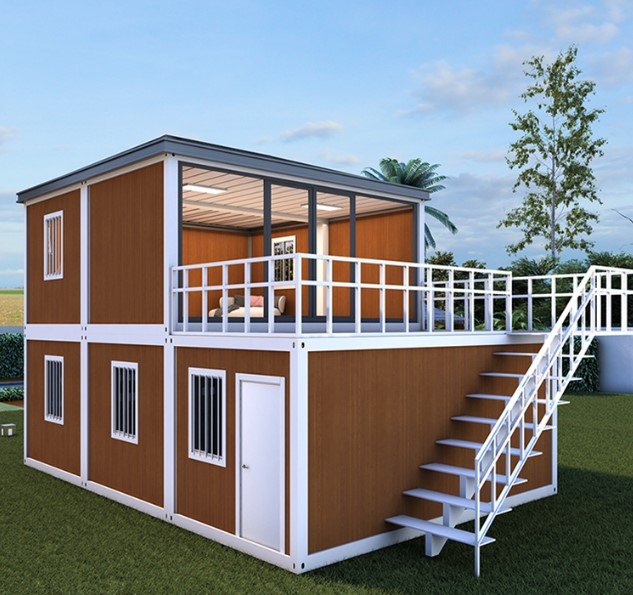
Customized Modular Units combine multiple containers or integrate specialized features like glass curtain walls, double-sloped roofs, and smart home systems for premium hospitality applications .
Step 3: Verify Structural and Safety Standards
Every prefabricated container house buying guide must address safety verification. Request these documents before purchase:
Structural Certification: Verify steel frame grade (Q235B minimum), welding quality (ultrasonic testing reports), and anti-corrosion treatment (sandblasting to Sa2.5, coating thickness ≥60μm) .
Fire Safety Documentation: Insulation materials should be rock wool or fire-rated PU panels with B1 rating or higher. Request fire test certificates for wall and floor assemblies .
Weather Resistance Data: Standard units should withstand ≥10-level winds and ≥7-degree seismic loads. Coastal and typhoon zones require enhanced specifications .
Step 4: Evaluate Insulation and Climate Adaptation
Insulation is where budget decisions most directly affect livability. A prefabricated container house buying guide should present clear climate-based recommendations:
| Climate Zone | Insulation Recommendation | Key Features |
|---|---|---|
| Temperate | 50mm EPS panels | Standard HVAC sufficient |
| Cold/Winter | 100mm rock wool + underfloor heating | Prevents condensation, retains heat |
| Tropical | Reflective coating + ventilation | Reduces solar heat gain |
| Coastal/Humid | Galvanized steel + enhanced waterproofing | Prevents salt corrosion |
For permanent residential use, the difference between an uninsulated and well-insulated unit can mean 5-8°C indoor temperature difference in winter .
Step 5: Calculate Total Landed Cost
A truly useful prefabricated container house buying guide must go beyond purchase price. Total investment includes:
Unit Cost: $4,000-$8,000 (standard 20ft) to $50,000+ (premium customized) .
Shipping: Foldable units maximize container utilization. Standard expanded units may require flat-rack shipping at 2-3x standard container rates .
Foundation: Concrete slab, gravel pad, or adjustable steel feet. Budget $500-$2,000 depending on site conditions.
Installation: DIY-capable for foldable units; crane required for standard containers ($300-$800/day).
Utilities: Electrical connection, water supply, drainage. Off-grid sites require solar + storage systems ($3,000-$10,000 additional).
Step 6: Verify Supplier Capabilities
The final section of any prefabricated container house buying guide must address supplier selection. Verify:
Production Capacity: Can the factory deliver on schedule? Request production line photos and recent client references.
Export Experience: Has the supplier shipped to your region? Compliance documentation varies by market (ANSI for US, CE for EU).
After-Sales Support: Is there a local partner for warranty claims, or must issues be resolved with the factory directly?
Customization Flexibility: Can the supplier adapt layouts, materials, and finishes to your specifications without excessive lead times?
For project inquiries and product catalogs, contact manager@ruhaimaterial.com or visit https://ruhaimaterial.com/products/ to explore available prefabricated container house solutions.
FAQ
1. What is the typical lifespan of a prefabricated container house?
With proper maintenance and quality steel (Q235B, 60μm+ coating), lifespan exceeds 15 years. High-end units with nano-coating can last 30 years .
2. How long does installation take?
Foldable units: 10-30 minutes with 4 workers. Standard containers: 1-3 days depending on foundation and utilities .
3. Can container houses be stacked or combined?
Yes. Standard units are designed for stacking up to 3 levels. Multiple units can be joined horizontally for larger spaces .
4. What foundation is required?
Level ground within ±50mm tolerance. Concrete slab preferred; gravel or timber pads acceptable for temporary installations.
5. Do container houses meet building codes?
Varies by jurisdiction. Request certification documentation (ANSI A119.5 for US) and verify local permitting requirements before purchase