
This capsule house guide provides essential guidance for buyers, hospitality operators, and developers evaluating space pod homes for purchase. Capsule houses offer compelling advantages—futuristic aesthetics, rapid deployment, and turnkey functionality—but also present unique considerations that this capsule house guide addresses comprehensively. From shipping logistics to regulatory compliance, understanding these critical factors will help you make an informed purchasing decision.
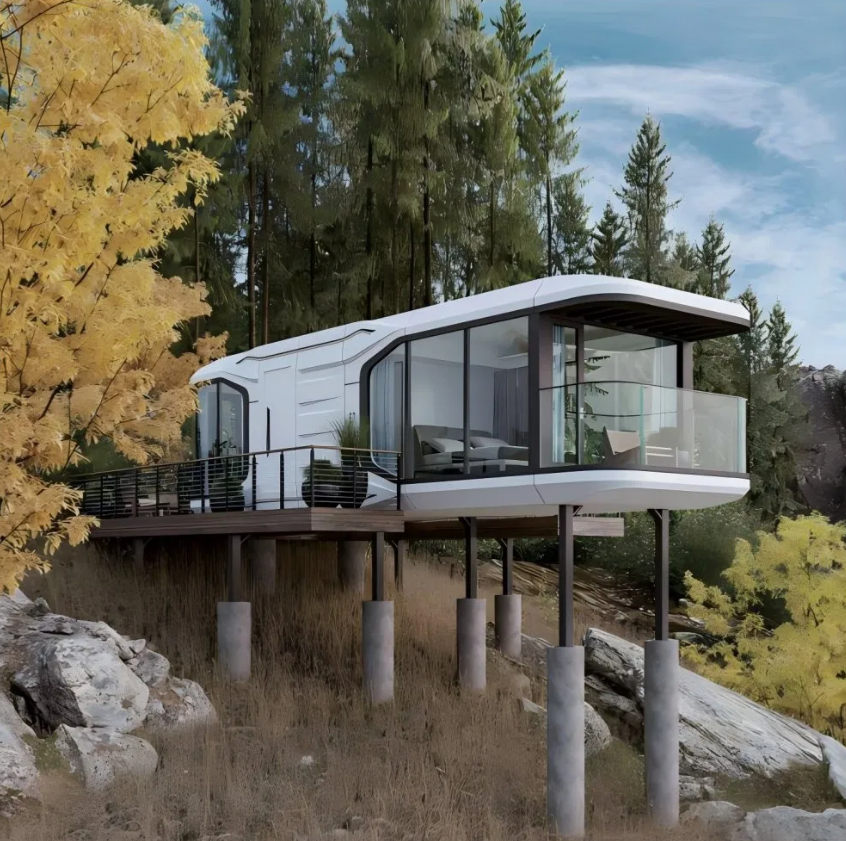
Understanding Capsule House Specifications
Capsule houses differ fundamentally from expandable container homes in size, shipping requirements, and customization scope. Standard models feature overall dimensions exceeding 3.2 meters in both height and width, meaning they cannot fit inside standard 40-foot shipping containers . This capsule house guide emphasizes that buyers must plan for either full-unit flat-rack shipping (one unit per container) or modular disassembly with on-site reassembly—a critical cost factor often overlooked in initial budgeting.
Available floor areas typically range from 17.92 square meters to 36.8 square meters, with standard layouts including one-bedroom/one-bathroom and two-bedroom/one-bathroom configurations . Random customization of overall dimensions and internal layouts is generally not available due to production standardization and structural design constraints.
Critical Factor 1: Define Your Purpose and Application
The capsule house guide begins with the most fundamental question: what is the intended use? Application determines optimal product specifications, pricing expectations, and regulatory requirements.
For Personal Residence: Prioritize living comfort, insulation performance, lifespan, and after-sales support. A capsule house for full-time occupancy requires more robust climate control and utility systems than a seasonal vacation unit.
For Resort or Glamping Projects: Calculate return on investment carefully. What is the overall project cost, and what are achievable nightly rental rates? Generally, a payback period of 3-5 years is considered reasonable for well-located capsule house projects .
For Resale or Distribution: Clearly define target customers, sales channels, and profit structure. Consider whether a showroom investment is necessary and verify compliance with local building regulations before committing to inventory.
Critical Factor 2: Assess Location and Climate Conditions
Capsule house performance varies significantly across climate zones. This capsule house guide recommends verifying specific environmental parameters before purchase.
For frigid regions, capsule houses can be equipped with additional underfloor heating systems or supplemental heating devices. Verify that the structure meets local snow load standards to withstand heavy snowfall. For tropical climates, confirm that air conditioning capacity is sufficient to cool the interior volume efficiently.
Location also determines utility connection requirements. Sites within municipal utility coverage can connect directly to public water, power, and sewage systems (subject to local authority approval). Remote off-grid locations require supporting infrastructure including solar energy storage, water tanks, and septic systems .
Critical Factor 3: Verify Certification and Regulatory Compliance
Certification status is arguably the most important purchasing factor in the capsule house guide. A unit without certification is legally considered a furniture purchase rather than a housing purchase—your insurer will treat it accordingly, and financing options may be unavailable .
For US markets, ANSI A119.5 certification is the benchmark for manufactured housing compliance. Buyers should request certification documentation in writing before paying any deposit. Clarify warranty terms and identify who handles warranty claims in your country—the factory directly or a local partner.
Housing-related regulatory standards differ widely across countries and regions. Some markets require official approval documents for customs clearance or construction filing. Reputable manufacturers can provide complete technical supporting documents or adjust product configurations to meet local standards .
Critical Factor 4: Calculate Total Landed Costs
The capsule house guide emphasizes that purchase price represents only a portion of total project cost. Budget must account for: optional upgrades and customizations, ocean freight (significantly higher for flat-rack shipping), foundation construction, on-site installation and assembly labor, and import tariffs and customs clearance fees.
Capsule houses cannot ship in standard containers, and full-unit flat-rack shipping costs two to three times standard 40HQ container rates . Modular disassembly reduces freight costs but adds on-site reassembly labor and potential quality inconsistency risks. This capsule house guide recommends full-unit flat-rack transport as the preferred method for quality assurance.
Critical Factor 5: Plan Utility Connections
Each capsule house ships with pre-installed reserved pipelines for water supply, power supply, and sewage discharge. This capsule house guide recommends developing a utility connection plan before delivery.
For municipal utility connections, connect directly to public pipelines—though official approval from local authorities may be required in advance. For remote sites, prepare supporting facilities such as solar energy storage systems, water storage tanks, and septic tanks. Confirm voltage and frequency compatibility with local power standards.
Critical Factor 6: Evaluate Customization Options
Unlike expandable houses, capsule houses offer limited customization scope. The capsule house guide advises buyers to confirm available options before placing orders: exterior color selections, wall panel materials, smart home system integration, and furniture and appliance selections.
All customized terms should be documented in writing before deposit payment. Manufacturers typically offer standard configurations with limited variance; buyers seeking extensive customization should consider expandable house alternatives.
Critical Factor 7: Assess Warranty and After-Sales Support
Warranty terms vary dramatically across manufacturers. The capsule house guide recommends requesting the warranty document in writing before payment and clarifying specific coverage: structural components, electrical systems, plumbing, and smart home devices.
Post-sale support infrastructure is equally important. Does the manufacturer have local partners for warranty claims, or must issues be resolved directly with the factory? For international buyers, local support presence significantly impacts long-term satisfaction.
Critical Factor 8: Plan for Installation and Site Preparation
Capsule house installation requires a crane or heavy lifting equipment for positioning. Site preparation includes level ground preparation, foundation construction (concrete slab, gravel pad, or metal foundation legs), and utility connection stubs. Installation typically takes 1-3 days depending on site readiness .
This capsule house guide recommends inspecting the site with the manufacturer’s installation team or a qualified local contractor before delivery. Verify that access routes can accommodate delivery vehicles and lifting equipment.
Maintenance and Long-Term Care
Capsule houses require minimal ongoing maintenance but benefit from regular inspection. Check sealed joints and waterproofing annually, particularly before rainy seasons. Inspect smart home system functionality and update software as needed. For units in coastal environments, apply corrosion protection to exposed metal components annually.
FAQ
1. What is a capsule house?
A capsule house is a compact prefabricated dwelling unit inspired by space capsule design, featuring curved profiles, panoramic windows, and integrated smart home technology. They are typically used for glamping, guest accommodation, and accessory dwelling applications .
2. How much does a capsule house cost?
Capsule house unit prices range from approximately $15,000 to $95,000 depending on size, features, and manufacturer. Total landed costs including shipping, foundation, and installation are significantly higher .
3. Can capsule houses ship in standard containers?
No. Capsule houses exceed standard container dimensions, requiring full-unit flat-rack shipping (one unit per container) or modular disassembly. Freight costs are two to three times standard container rates .
4. Do capsule houses require certification?
Yes, for housing applications. ANSI A119.5 is the benchmark for US markets. Uncertified units are treated as furniture purchases, affecting insurance and financing eligibility .
5. What is the typical payback period for a capsule house glamping project?
For well-located glamping projects, a payback period of 3-5 years is considered reasonable, depending on local nightly rates and occupancy levels .
6. Can capsule houses be used off-grid?
Yes, with supporting infrastructure. Off-grid installations require solar energy storage systems, water storage tanks, and septic systems. Capsule houses ship with pre-installed utility connection points
Welcome to contact us for more information. manager@ruhaimaterial.com;capsule house guide