
The prefabricated container house industry trends in 2026 reveal a sector undergoing fundamental transformation—from niche alternative housing to a mainstream construction solution with global supply chains and institutional investment. The global container homes market was valued at USD 75.1 billion in 2025 and is projected to reach USD 112.14 billion by 2034, growing at a 5.14% CAGR . This prefabricated container house industry trends analysis examines the forces reshaping the market and identifies strategic opportunities for developers, investors, and suppliers.
Market Growth Drivers: Why Container Housing Is Scaling Now
Understanding prefabricated container house industry trends requires examining the convergence of demand-side pressures and supply-side capabilities.
Housing Affordability Pressure: Urban land costs and construction labor shortages have pushed conventional housing beyond reach for many demographics. Container homes offer 30-50% cost savings compared to traditional construction in many markets, with faster delivery times . North America currently holds the largest market share at 35-38%, driven by accessory dwelling unit (ADU) adoption and backyard cabin demand .
Sustainability Priorities: Steel structures align with circular economy principles. Reused containers avoid new steel production, while factory fabrication reduces construction waste from 8-12% (traditional sites) to 3-5% (controlled production) . Developers increasingly specify container systems to meet environmental targets.
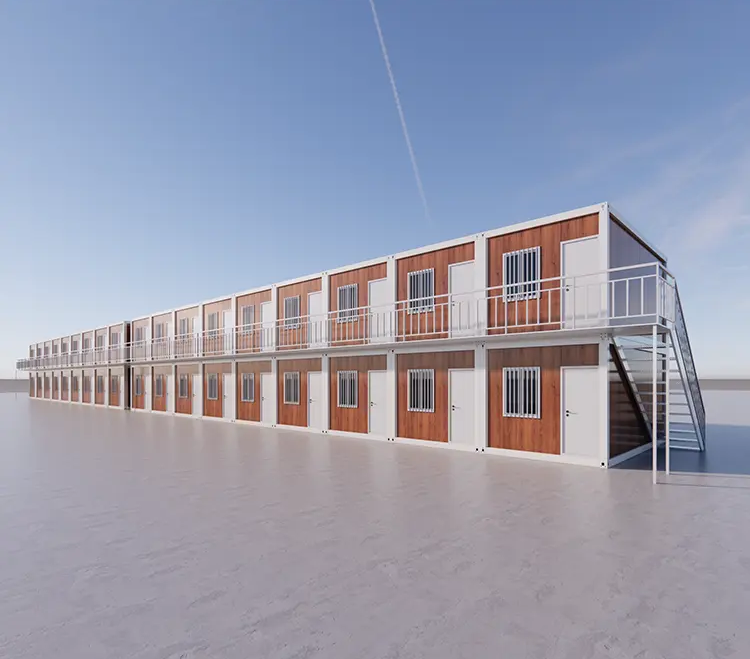
Remote and Temporary Accommodation Demand: Construction, mining, and infrastructure projects require robust, relocatable housing. Container units suit these applications with stacking, anchoring, and repositioning capabilities .
Technological Transformation: The Factory Becomes the Construction Site
The most significant prefabricated container house industry trends is the shift from site-built to factory-built production. Chinese manufacturers now operate smart production lines capable of outputting 50 modules per day—ten times the productivity of comparable North American facilities .
Digital Design Integration: Configurator platforms allow buyers to select layouts, façades, and finishes before production begins, reducing design cycles and costly rework .
Smart Building Integration: IoT devices, app-controlled HVAC, and automated lighting are becoming standard in premium units, enhancing comfort and energy efficiency .
Quality Traceability: Each module receives a unique digital ID, tracking materials, tolerances, and inspections from production through delivery .
Regional Market Dynamics
prefabricated container house industry trends vary significantly across regions.
North America: Dominated by residential ADU and glamping applications. Market share of 35-38%, with 4.8-5.6% CAGR projected . Key challenge: fragmented building codes across states.
Asia-Pacific: Manufacturing hub for global supply. China’s prefab construction exports grew 45% in Q1 2026 alone, with Shenzhen Port alone shipping ¥1.68 billion in “mobile housing” products . Domestic demand also rising for tourism and rural development.
Europe: Sustainability-driven market. High acceptance of modular solutions but stringent certification requirements (CE marking, fire performance) .
Middle East and Africa: Strong demand for workforce camps and rapid infrastructure. Projects in mining, logistics, and energy sectors drive adoption .
Investment Opportunities and Strategic Considerations
For investors and developers analyzing prefabricated container house industry trends, several opportunities stand out:
Institutional Affordable Housing: Public agencies and nonprofits are creating repeatable programs where land, financing, and permitting are coordinated in advance. Container systems offer speed and cost predictability .
Hospitality and Eco-Tourism: Container units enable phased investment and seasonal flexibility for resort operators. Premium interiors and off-grid utilities support higher nightly rates .
Workforce Accommodation: Mining, energy, and infrastructure projects require durable, relocatable housing near remote sites. Container camps offer faster deployment than conventional construction .
Hybrid Communities: Developers are combining containers with timber frames and light-gauge steel to create mixed-material communities that avoid purely industrial aesthetics .
Challenges and Risk Factors
prefabricated container house industry trends also reveal persistent challenges:
Regulatory Fragmentation: Building codes vary by jurisdiction. Certification requirements (ANSI, CE, local standards) add cost and complexity .
Supply Chain Volatility: Steel prices and container availability fluctuate. Shipping costs for expanded units can reach 2-3x standard container rates .
Quality Inconsistency: Low-cost producers sometimes cut corners on insulation, waterproofing, and structural integrity. Buyer verification is essential .
Financing Barriers: Uncertified units may be treated as furniture rather than real property, complicating mortgage and insurance access .
Future Outlook: 2026-2034
prefabricated container house industry trends point toward continued expansion. The market is projected to grow from $75.1 billion (2025) to $112.14 billion (2034) . Key developments to watch:
Standardization: Industry consolidation around certified designs and transparent specifications will reduce buyer risk.
Technology Integration: AI-assisted design, automated production, and smart building systems will improve quality and reduce costs.
Hybrid Models: Container core with conventional additions will become mainstream for residential and hospitality projects .
Green Certification: Low-carbon steel, recycled materials, and energy-efficient systems will become competitive differentiators.
For partnership inquiries and product information, contact manager@ruhaimaterial.com or explore https://ruhaimaterial.com/products/.
FAQ
1. How fast is the prefabricated container house market growing?
The global container homes market is projected to grow from $75.1 billion (2025) to $112.14 billion (2034), at a 5.14% CAGR. Broader container homes market shows 7.5% CAGR in some forecasts .
2. What are the main drivers of container house industry growth?
Housing affordability pressure, sustainability priorities, remote accommodation demand, and technological advancements in modular construction .
3. Which regions offer the best opportunities?
North America (ADU and glamping), Asia-Pacific (manufacturing and domestic demand), and Middle East (workforce camps and infrastructure). Europe offers premium sustainability-focused projects .
4. What are the biggest challenges for the industry?
Regulatory fragmentation, supply chain volatility, quality inconsistency among low-cost producers, and financing barriers for uncertified units .
5. How is technology changing container house production?
Smart factories with 50-unit daily capacity, digital design configurators, IoT-enabled building systems, and full quality traceability through unique module IDs .
6. Is container housing sustainable?
Yes. Reused steel aligns with circular economy principles. Factory production reduces waste from 8-12% (traditional) to 3-5%. Solar integration and energy-efficient systems further reduce operational carbon