
Author: Rhmaterial – Premium Metal Materials & Prefab Solutions for Global Builders
Container house price is the most scrutinized—and most commonly misjudged—factor in procurement decisions. Most buyers focus only on the factory quote during the inquiry stage, overlooking hidden costs such as ocean freight, tariffs, foundation construction, and on-site installation, which can push final landed costs 40%-60% beyond budget. In 2026, with steel price fluctuations and shifting ocean freight rates, the container house price structure is undergoing new changes. This guide systematically breaks down the complete logic of container house pricing across four dimensions: quote composition, influencing factors, cost control, and pitfalls to avoid.
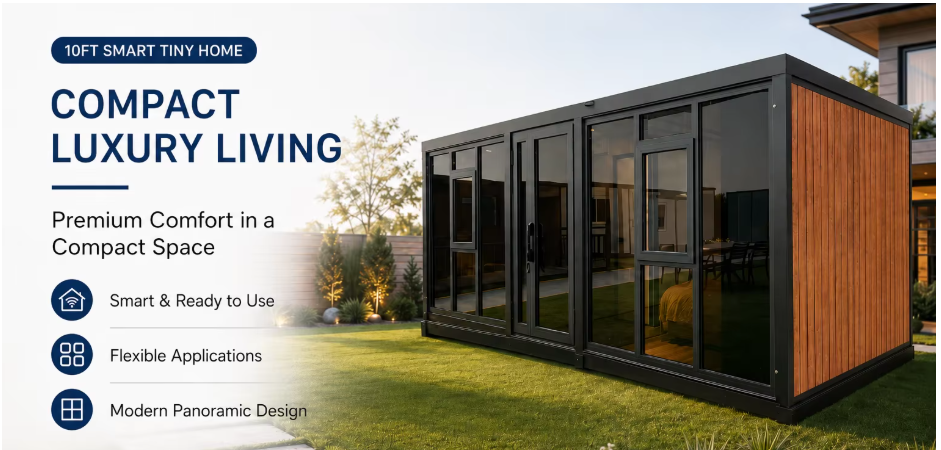
Core Components of Container House Price
What the Factory Quote Covers
Understanding the complete container house price structure…Factory quotes typically cover the structural body, including steel frame, enclosure panels, doors and windows, basic plumbing and electrical pre-embedding, and interior finishes. For a standard 20ft unit, the 2026 factory quote range is $3,800-$8,000 (FOB). Standard 40ft units range from $8,000-$13,800. Premium expandable units can reach $28,000-$35,000.
Note that factory quotes generally exclude: furniture and appliances, air conditioning systems, solar components, and on-site installation labor.
For global steel price benchmarks, refer to the World Steel Association‘s monthly steel price reports, which track hot-rolled coil and rebar pricing across major markets.
The Complete Landed Cost Chain
From factory to occupancy, the complete container house price chain includes six stages:
- Factory quote: structural body and basic interior
- Ocean freight: approximately $2,000-$8,000 for a 20ft container to most destinations
- Tariffs and customs clearance: varies by country, typically 5%-15% of cargo value
- Foundation construction: concrete strip footing or screw piles, approximately $500-$2,000
- On-site installation: hoisting and assembly, approximately $300-$800 per day
- Utility connection: municipal grid connection or off-grid systems, approximately $1,000-$10,000
Full landed costs typically run 1.5-2.5 times the factory quote.
Volume Purchasing Advantages
Order scale directly affects container house price. Orders of 20+ units typically qualify for 5%-12% tiered discounts. For homestay projects and construction camps, bulk purchasing not only lowers unit price but also amortizes fixed shipping and customs clearance costs.
Six Variables Affecting Container House Price
Size Specifications and Steel Grade
The price difference between 20ft and 40ft units is approximately 60%-80%. For steel grade, Q235 carbon steel is the standard configuration, while galvanized or weather-resistant steel (such as Q355) adds 15%-25% to cost but significantly extends service life in coastal and high-humidity environments.
International shipping cost fluctuations can be tracked via the UNCTAD Review of Maritime Transport, which publishes annual container freight rate indices.
Insulation Level and Fire Requirements
EPS panels offer the lowest cost, rock wool panels cost 30%-50% more but provide Class A fire performance, and polyurethane panels fall in between. For commercial scenarios with fire approval requirements, the rock wool premium can be partially offset by insurance rate discounts.
Interior Standard and Customization Level
The price difference between basic finishes (utilities in place, flooring and walls) and premium finishes (complete kitchen and bath, furniture and soft furnishings) can reach 2-3 times. Highly customized irregular designs, large glass curtain walls, and smart home systems further drive up costs.
Delivery Distance and Transport Mode
Foldable units can load 2-4 sets in a single 40HQ container, significantly reducing per-unit shipping costs. Standard container units are billed per full container. Ocean routes and inland transfer costs vary considerably—request CIF or DDP quotes from suppliers for comparison.
Procurement Timing and Exchange Rates
Steel prices exhibit cyclical fluctuations. Locking in orders during steel price lows can save 5%-10% on structural costs. Meanwhile, USD-denominated exchange rate fluctuations also affect final local currency costs.
Certification and Compliance Costs
Certifications such as ANSI A119.5 (US) and CE (EU) add testing and documentation costs, but uncertified products may face insurance claim rejection and financing obstacles. Certification premiums typically run 5%-8%, representing a necessary investment.
For US market compliance, reference the U.S. Department of Housing and Urban Development (HUD) manufactured housing standards, which outline ANSI A119.5 requirements for prefabricated structures.
Container House Price Cost Control Strategies
Strategy 1: Define Requirements, Avoid Over-Configuration
Homestay projects don‘t need industrial-grade fire ratings; construction camps don’t need premium finishes. Matching configuration to actual use scenarios avoids 20%-30% in unnecessary expenditure.
Strategy 2: Prioritize Foldable Units to Reduce Transport Costs
While foldable container houses have slightly higher factory prices per unit, transport efficiency improves 2-4 times, often resulting in lower comprehensive landed costs.
Strategy 3: Bulk Purchase to Lock in Steel Prices
Concentrated ordering not only secures tiered discounts but also locks in costs during steel price lows. Determine total demand during the project planning phase.
Strategy 4: Localize Foundation Construction
Foundation work and on-site installation can be contracted to local builders, avoiding high travel expenses from supplier-dispatched crews.
Strategy 5: Itemized Quotes for Line-by-Line Comparison
Request itemized quotes rather than package totals. Line-by-line comparison identifies where premiums exist.
Common Misconceptions About Container House Price
Misconception 1: Factory price equals landed price. Factory quotes cover only the structural body. Landed costs typically run 1.5-2.5 times the factory price.
Misconception 2: Lower price equals better value. Overly low quotes may indicate insufficient steel thickness, substandard coatings, or skipped quality inspections—resulting in higher long-term repair costs.
Misconception 3: Ignoring certification costs. Uncertified products may incur additional costs in insurance, financing, and approval processes—or may not be legally usable at all.
Misconception 4: One-time procurement is optimal. For phased projects, batch procurement reduces capital occupation but requires weighing steel price fluctuation risks.
FAQ
Q1: How much does a container house cost?
Basic 20ft unit factory prices range from approximately $3,800-$8,000, while premium 40ft expandable units range from $28,000-$35,000. Full landed costs run 1.5-2.5 times the factory price, including shipping, tariffs, foundation, and installation.
Q2: What factors affect container house price?
Main factors include size specifications, steel grade, insulation and fire rating, interior standard, delivery distance, and order volume. Steel price fluctuations and exchange rate changes also affect final costs.
Q3: How can I reduce container house price?
Define requirements to avoid over-configuration, prioritize foldable units to reduce transport costs, bulk purchase to lock in steel prices, localize foundation construction, and request itemized quotes for line-by-line comparison.
Q4: Does container house price include furniture and appliances?
Usually not. Factory quotes typically cover only the structural body and basic interior. Furniture, appliances, air conditioning, and solar components require separate procurement or supplier configuration.
Q5: How much discount can bulk container house purchases get?
Orders of 20+ units typically qualify for 5%-12% tiered discounts. Bulk purchasing also amortizes fixed shipping and customs clearance costs, delivering more pronounced comprehensive savings.
Summary
Container house price is not a single number but a complete cost chain from factory to occupancy. Understanding the cost composition at each stage and identifying key price variables puts you in an advantageous position during procurement negotiations. For budget-sensitive buyers, request itemized quotes and landed cost estimates during the inquiry stage to avoid budget overruns later.
For container house itemized quotes or cost optimization solutions, contact:
📧 manager@ruhaimaterial.com